

Staff augmentation for architecture firms can push billable utilization from 61% toward 90% while cutting the 162% overhead burden. Here’s the exact math.
Architecture firms are running a quiet financial leak: the median billable utilization rate across U.S. firms is 61%, meaning nearly 40% of paid labor hours generate zero revenue (Deltek Clarity A&E Industry Study, 2023). At the same time, firms carry a 162% overhead rate – for every $1.00 spent on direct labor, $1.62 goes to indirect costs. Staff augmentation for architecture firms is one of the few levers that addresses both problems simultaneously. This post shows the exact math.
Why Architecture Firm Financials Are Under Pressure in 2026
Three forces are converging on A&E firm margins right now. First, the talent supply is shrinking: the number of licensed architects in the U.S. declined roughly 4% in 2024 to approximately 116,000, even as project pipelines expand. Second, hiring is slow – wait times of 45-60 days are typical to fill a qualified Revit drafter role in markets like California, New York, and Texas, stretching to 12+ weeks for senior BIM talent. Third, 78% of AEC firms reported difficulty filling salaried roles in AGC’s 2025 survey, making traditional hiring an unreliable capacity strategy.
Firms pay full overhead for staff they cannot fully deploy, while simultaneously failing to hire fast enough to capture available work.
What the Utilization Rate Numbers Actually Mean for Your Firm
Billable utilization rate is the ratio of billable hours to total paid hours. At 61% utilization, a mid-level Revit drafter earning $78,000/year generates billable output for only approximately $47,580 of that salary, while non-billable time absorbs the remaining $30,420.
According to BQE benchmarks, top-quartile architecture firms maintain an average utilization rate of 82.4%, while bottom-quartile firms average 71.1%. That 11-percentage-point gap translates to hundreds of thousands in lost billable hours annually for a mid-sized firm. The industry sweet spot identified by Monograph benchmark data is 75-90% billable utilization – top firms log roughly 10 more billable hours per person per week than bottom-quartile peers. BIM and CAD production staff at AI-integrated firms run 94% utilization compared to 90% at baseline firms, demonstrating that workflow choices directly affect the utilization ceiling. A utilization rate below 70% is a leading indicator of margin compression, not just a staffing inefficiency metric.
Breaking Down the True Cost of an In-House Revit Drafter
A 162% overhead rate means a drafter with a $78,000 base salary actually costs the firm approximately $204,360 in fully-loaded annual expense (Deltek, 2023). The indirect cost components driving that multiplier include employer payroll taxes, health and dental benefits, paid time off, office space, software licenses, equipment, HR administration, and recruiting fees.
Critically, the overhead burden remains fixed regardless of project volume. A drafter sitting between project phases still carries the full 162% multiplier against zero billable output. Recruiting and onboarding costs for a licensed Revit drafter in a competitive market can add $15,000-$25,000 in one-time costs on top of the ongoing overhead burden (BetterPros, 2026). Firms that shift production capacity to variable-cost models can structurally lower their effective overhead rate during slow periods without sacrificing delivery capability.
What Is Staff Augmentation and How Does It Work?
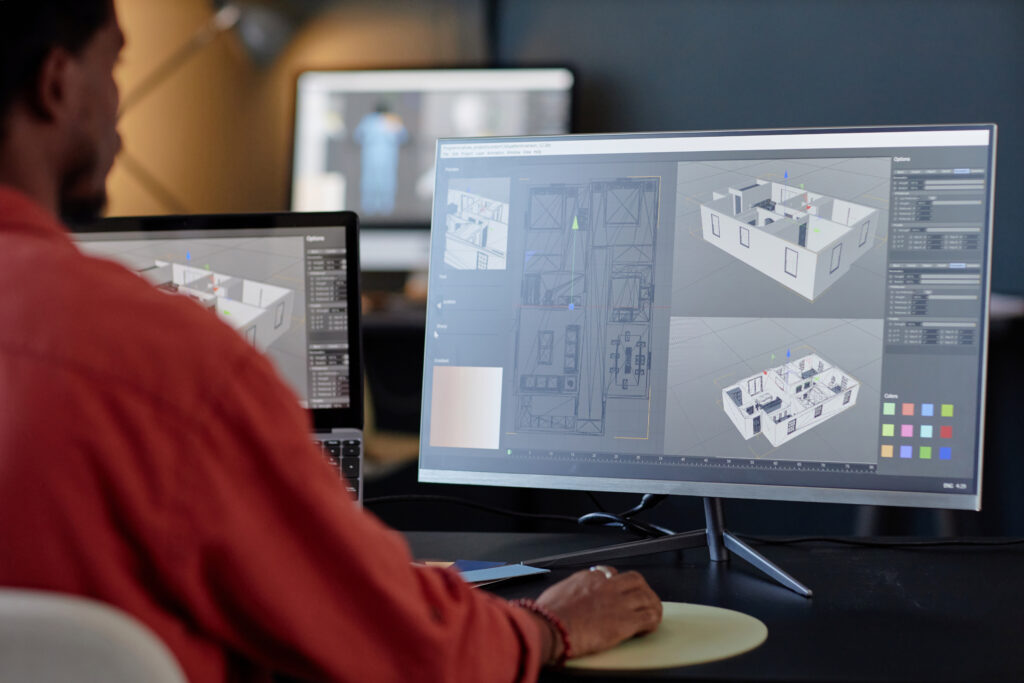
Staff augmentation for architecture firms is a workforce model in which the provider embeds dedicated, experienced remote professionals, such as architects, Revit drafters, and BIM coordinators, directly into the firm’s existing tools, workflows, and communication channels. Unlike project-based outsourcing, augmented staff work exclusively for one firm, maintain continuity across projects, and operate within the firm’s standards and software environment.
The embedded model means augmented professionals attend team meetings, respond in real time, and build institutional knowledge – functioning as a remote team member rather than an external vendor. Same-timezone staffing models eliminate the communication lag that makes traditional offshore models difficult to integrate into live project workflows. The provider manages HR, compliance, performance oversight, and continuity, so the firm receives production capacity without the administrative burden of direct employment.
The Difference Between Augmentation and Outsourcing in AEC
| Dimension | Staff Augmentation | Outsourcing |
| Who manages delivery | Client firm | External vendor |
| Workflow integration | Embedded in client’s tools and processes | Separate vendor workflow |
| Project management authority | Client retains full control | Vendor controls execution |
| Continuity across phases | High – same dedicated professional | Low – vendor assigns resources |
| Best suited for | Ongoing production capacity | Discrete, repeatable scopes |
| Institutional knowledge | Builds over time | Resets with each engagement |
| Visibility into production | Full | Limited |
For architecture firms managing multi-phase projects with evolving scope, staff augmentation preserves institutional knowledge and reduces the rework cost associated with handing off work to external teams mid-project.
Comparing In-House vs. Augmented Revit Drafter Costs
| Cost Factor | In-House Drafter | Augmented Remote Drafter |
| Base salary | $78,000 | Included in service fee |
| Fully-loaded annual cost (162% overhead) | ~$204,360 | 40-60% lower than FTE equivalent |
| Non-billable salary at 61% utilization | $30,420/year | Reduced – dedicated project assignment |
| Recruiting and onboarding (one-time) | $15,000-$25,000 | $0 |
| Cost during slow periods | Full overhead continues | Scales down with project volume |
| Time to productivity | 45-60+ days to hire | Compressed onboarding |
The break-even point for shifting surge-period capacity to an augmented model typically occurs within the first project phase for firms with utilization below 70%. Firms that use augmented staff for production work during peak periods and scale back during slow periods convert a fixed overhead liability into a variable cost that tracks actual project revenue.

How to Improve Your Architecture Firm’s Billable Utilization Rate
- Step 1 – Measure by role: Calculate billable hours divided by total paid hours for each production staff member over the trailing 90 days. Identify where non-billable time is concentrated.
- Step 2 – Identify utilization drag: Common culprits: bench time between project phases, administrative tasks assigned to billable staff, and onboarding time during surge periods.
- Step 3 – Separate fixed from variable capacity needs: Core staff should cover baseline project load. Surge capacity above that baseline is a candidate for augmented staffing rather than new hires.
- Step 4 – Model the revenue impact: Estimate how many additional billable hours would be produced if in-house staff were freed from non-billable tasks. Calculate the revenue value of closing the gap to the 80-90% benchmark.
- Step 5 – Track utilization weekly: Firms that review utilization weekly can make resourcing adjustments before project margins are impacted, rather than after.
The North American BIM market is projected to grow 12% annually through 2026 (Primaverse, 2026). Firms that build scalable, variable-cost production capacity now are positioned to capture that growth without proportional overhead increases.
FAQ: Staff Augmentation for Architecture Firms
How does staff augmentation work for A&E firms?
Staff augmentation embeds dedicated remote architects, Revit drafters, or BIM coordinators directly into the firm’s existing workflows, tools, and communication channels. The provider handles HR and compliance; the firm retains full project management authority.
Can a remote Revit drafter work in the same time zone as my in-house team?
Yes. Nearshore and globally distributed staffing models specifically align working hours with the client firm’s time zone, which enables real-time collaboration and eliminates the overnight turnaround delays common in traditional offshore models.
What is the average overhead rate for an architecture firm?
The average overhead rate for U.S. architecture firms sits at 162%, meaning that for every $1.00 a firm spends on direct labor, it spends an additional $1.62 on indirect costs including benefits, office space, and non-billable time.
How much does a fully-loaded Revit drafter cost an architecture firm?
A mid-level Revit drafter earning $78,000 in base salary costs approximately $204,360 per year at a 162% overhead rate, plus $15,000-$25,000 in one-time recruiting and onboarding costs in competitive markets
What is the difference between staff augmentation and outsourcing in AEC?
Outsourcing transfers a defined scope to an external firm that manages delivery independently. Staff augmentation adds dedicated individuals who work inside the client firm’s team, follow its standards, and attend its meetings – the client retains full project management control.
How can architecture firms reduce overhead during slow project periods?
Shifting production capacity from fixed full-time headcount to a variable augmented staffing model allows firms to scale down during slow periods without carrying the full 162% overhead multiplier against zero billable output.
How do remote BIM teams integrate into an existing Revit workflow?
Successful integration requires the augmented professional to work within the firm’s Revit templates, BIM execution plans, and naming conventions from day one. Cloud collaboration platforms such as BIM 360 and Autodesk Construction Cloud (ACC) enable real-time model access without version-control conflicts.

Building Margin vs. Burning It
The utilization rate and overhead multiplier are not abstract KPIs – they are the two numbers that determine whether your firm is building margin or burning it. Closing the gap from 61% to 80%+ utilization while converting fixed overhead into variable cost is the structural shift that separates top-quartile firms from the rest.
If you’d like to see how Bizforce approaches this, we’d love to talk. Contact us here.